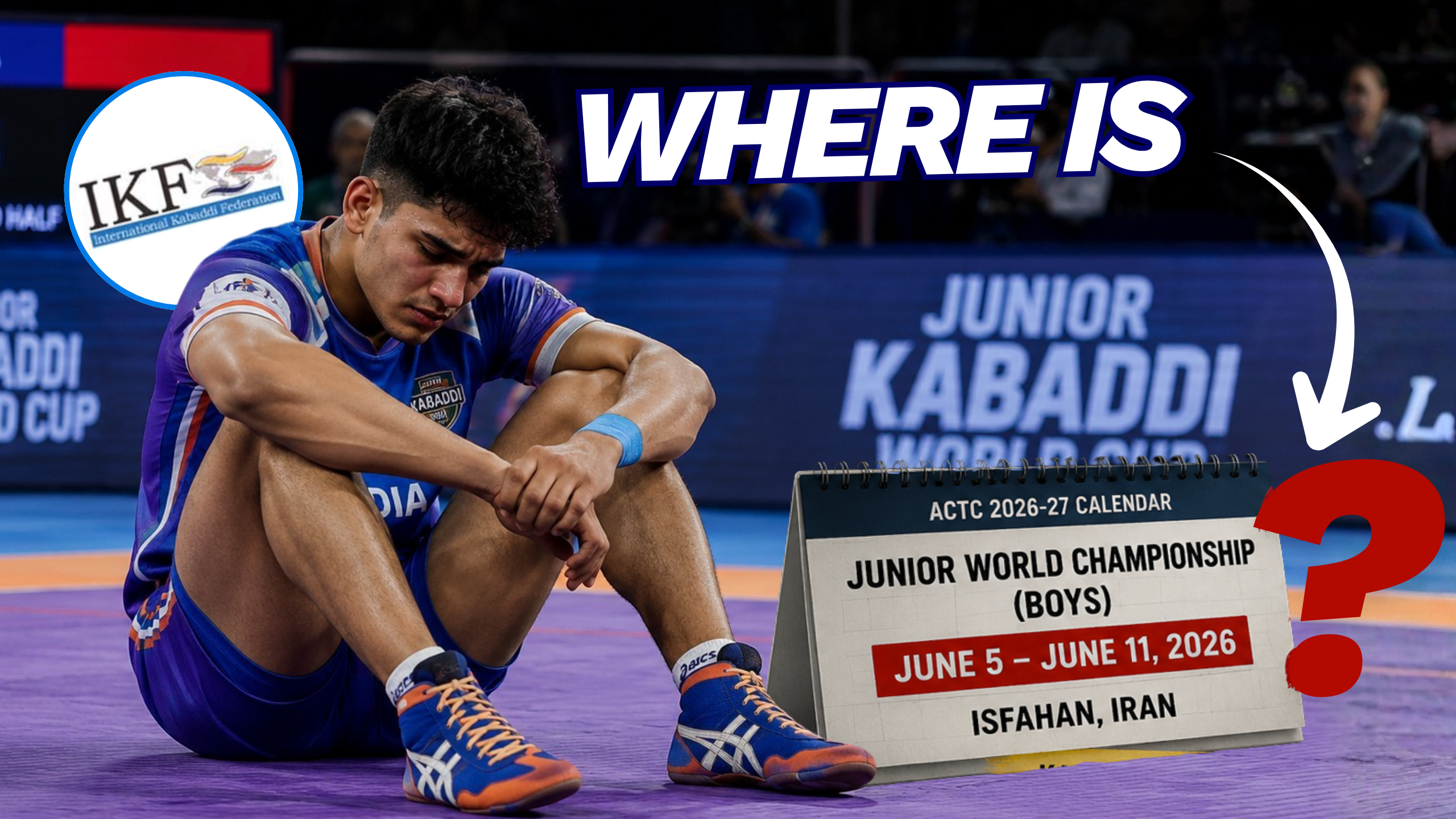
Kabaddi Deserves Better: Why the Silence Around the Junior World Championship Should Concern Every Fan
A World Championship was supposed to be taking place this week, yet fans, players, and federations have been left searching for answers. As the Junior World Championship 2026 passes without visible updates, the silence from kabaddi's governing bodies has reignited concerns about transparency, communication, and the professional future of the sport.
A World Championship Is Supposed To Be Happening Right Now. So Why Does Nobody Know About It?
Imagine if the FIFA World Cup was scheduled to begin this week and nobody knew whether the matches were being played.
Imagine if the ICC announced a Cricket World Cup, published the dates, selected the venue, and then simply went silent as the tournament approached.
The outrage would be immediate.
Yet in kabaddi, something remarkably similar appears to be happening.
According to the officially circulated ACTC 2026-27 calendar, the Junior World Championship (Boys) was scheduled to be held in Isfahan, Iran, from June 5 to June 11, 2026.
Today, we are already at the end of that scheduled window.
And yet, there has been no official communication that most fans can find.
No fixture list.
No participating squad announcements.
No official live streaming information.
No daily match reports.
No opening ceremony coverage.
No public statement regarding postponement.
No public statement regarding cancellation.
Nothing.
For a tournament carrying the title of "World Championship," the silence is impossible to ignore.
The Question Is Not Whether Iran Is Safe. The Question Is Why Nobody Is Talking.
Let's be clear.
International sport does not exist in a vacuum.
Geopolitical tensions, security concerns, travel restrictions, and regional instability can force organizers to postpone, relocate, or cancel events.
If the Junior World Championship could not be held in Iran because of security concerns, athlete safety, or logistical challenges, that is understandable.
In fact, it would be the responsible decision.
What is difficult to understand is the absence of communication.
Athletes deserve clarity.
National federations deserve clarity.
Sponsors deserve clarity.
Most importantly, fans deserve clarity.
Modern sports governance is built on transparency. When circumstances change, governing bodies communicate.
They explain.
They update.
They inform.
Silence is not communication.
Unfortunately, This Is Not The First Time
What makes the current situation more concerning is that it appears to follow a pattern.
Kabaddi fans witnessed a similar situation during preparations for the 2nd Women's Kabaddi World Cup.
Initially, the tournament was expected to be hosted in Rajgir, Bihar.
An official agreement was publicly celebrated.
Then the event was moved.
Later, it was shifted again.
Eventually, the tournament was hosted in Dhaka, Bangladesh.
The competition finally happened, and India emerged victorious.
But the journey from Bihar to Hyderabad to Dhaka exposed a troubling reality: uncertainty had become normal.
Instead of clear communication, stakeholders were left relying on rumours, social media posts, and unofficial sources.
A global sport cannot operate like this.
Kabaddi Wants Olympic Recognition. Professionalism Must Come First.
Kabaddi has spent years trying to establish itself on the world stage.
The sport has expanded into multiple countries.
Professional leagues have increased visibility.
Players have become role models.
Fans have embraced the game with incredible passion.
Yet international recognition is not earned only through exciting matches.
It is earned through professional administration.
Global sports organizations are judged not only by the quality of competition but by the quality of governance.
Scheduling.
Communication.
Transparency.
Accountability.
These are not optional extras.
They are fundamental requirements.
When world championships disappear from public discussion without explanation, it damages credibility.
When stakeholders are forced to search for answers instead of receiving them, trust begins to erode.
The Biggest Losers Are The Players
Behind every international tournament are young athletes who dedicate years of their lives to reaching the highest level.
For many junior players, a World Championship is the opportunity of a lifetime.
They train.
They sacrifice.
They dream of representing their nation.
The least they deserve is clear communication about the competitions they have worked so hard to reach.
Players should never be left wondering whether a World Championship is taking place.
This Is Not An Attack. It Is A Request.
The purpose of raising these questions is not to attack any individual, federation, or governing body.
The purpose is accountability.
Kabaddi deserves professional standards.
Fans deserve information.
Players deserve respect.
And the global growth of the sport depends on transparency.
If the Junior World Championship has been postponed, tell us.
If it has been relocated, tell us.
If it has been cancelled, tell us.
Just tell us.
Because silence is not leadership.
And a sport with Olympic ambitions cannot afford to communicate like a neighborhood tournament.
Kabaddi deserves better.
The players deserve better.
The fans deserve better.
And the future of the sport depends on it.
Subscribe once to comment — we'll email you a link to confirm. You'll also get our Kabaddi newsletter, unsubscribe anytime. We send at most 3 emails a day.
Be the first to comment.